
The Rules Changed
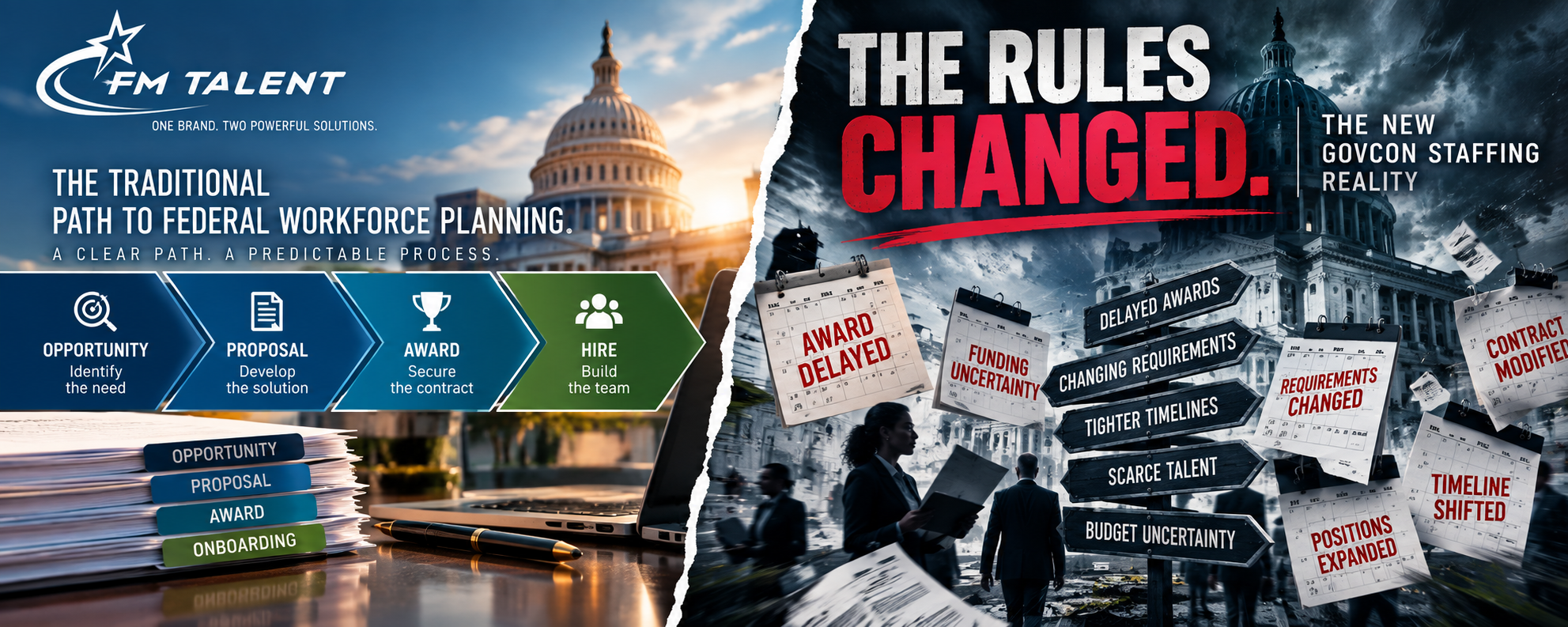
The New GovCon Staffing Reality
THE NEW GOVCON STAFFING REALITY
The Rules Changed: What Today’s Federal Market Means for GovCon Workforce Strategy
The work hasn’t disappeared. The certainty has.
For years, government contractors have understood that uncertainty comes with the territory.
Budgets change. Awards get delayed. Procurements get protested. Continuing resolutions disrupt timelines. Priorities shift.
But the environment contractors are navigating today feels different, not because federal contracting has disappeared, but because several forms of disruption are happening at once.
Federal agencies have experienced significant workforce reductions. Contracts have been reviewed, modified and terminated. Funding uncertainty continues to affect procurement timelines. Agencies are operating with fewer people in some areas while still being responsible for carrying out complex missions.
And government contractors are being asked to make workforce decisions inside that uncertainty.
Do we hire now?
Do we wait?
Do we build a candidate pipeline for an opportunity that could be delayed?
How much recruiting capacity should we maintain when we don’t know exactly when the demand will arrive?
These aren’t simply recruiting questions anymore.
They’re business strategy questions.
And for small and mid-sized government contractors in particular, getting the answers wrong can be expensive.
Welcome to The New GovCon Staffing Reality.
The Federal Workforce Has Changed, Significantly
The scale of federal workforce change provides important context.
According to the U.S. Government Accountability Office (GAO), nearly 378,000 employees separated from 22 major federal agencies during 2025, while approximately 127,000 were hired. From December 2024 to January 2026, the combined workforce across those agencies declined by nearly 256,000 employees, or more than 11%. Eighteen of the 22 agencies experienced declines greater than 10%. Government Accountability Office
Some agencies have also reported the loss of substantial institutional knowledge. At the Office of Personnel Management, for example, headcount declined 35% between December 2024 and March 2026, and 57% of departing employees had at least 11 years of service. Government Accountability Office
That doesn't automatically mean contractors will replace departing federal employees. Missions can be reorganized, reduced, automated, brought in-house or contracted out depending on the agency, funding and requirement.
But it does mean the environment surrounding federal work has changed.
The Contracting Market Hasn't Disappeared
This distinction matters.
It would be easy to look at agency reductions and procurement disruption and conclude that government contracting itself is disappearing.
The numbers don't support that conclusion.
The Small Business Administration reported that small businesses received nearly 28% of federal prime contracting dollars in FY2025, approximately $179 billion. When prime contracts and subcontracts are combined, SBA reported nearly $273 billion going to small businesses. Small Business Administration
Federal agencies still have missions to perform.
Technology must operate.
Programs must be managed.
Financial systems must function.
Cybersecurity threats must be addressed.
Citizens still require services.
Infrastructure must be maintained.
And agencies will continue using contractors to support portions of that work.
The opportunity remains.
What has changed is the level of predictability surrounding it.
Rule #1 Changed:
You Can't Build Workforce Plans Around Perfect Timing
Imagine this scenario.
Your company identifies an opportunity.
You know the probable labor categories.
Your team spends months developing the proposal.
You submit.
And then you wait.
The anticipated award date moves.
Funding changes.
Requirements are modified.
Procurement strategy shifts.
Or the award arrives, and suddenly the clock starts.
This creates an uncomfortable workforce dilemma.
Recruit too aggressively before award and you may invest resources against revenue that hasn't materialized.
Wait until everything is certain and you may find yourself trying to source, qualify and hire an entire workforce during an aggressive mobilization period.
Neither extreme is ideal.
Today's environment increasingly rewards a third approach:
Prepare early. Scale deliberately.
Rule #2 Changed:
Recruiting Can't Start at Award
This was the mystery behind our recent FM Talent Knows: Case File #003.
The fictional contractor had:
27 positions.
45 days.
Zero candidates ready.
Everyone looked for the culprit.
Was it the tight labor market?
Clearance requirements?
Compensation?
The recruiting team?
But the evidence pointed somewhere else.
The candidates weren't missing. The pipeline was.
The company knew about the opportunity months earlier.
It knew the likely positions.
It knew the requirements.
But recruiting didn't meaningfully begin until the award arrived.
That's an important distinction between hiring and workforce readiness.
You may not be ready to hire someone six months before award.
That doesn't necessarily mean you should know nothing about the talent market until six weeks before performance begins.
Rule #3 Changed:
Your Talent Pipeline Is Part of Your Capture Strategy
Traditionally, organizations can treat capture, proposal development and recruiting as distinct activities.
Today's environment makes those walls increasingly difficult to maintain.
Consider the questions workforce leaders can help answer during pursuit:
What roles will be hardest to fill?
Where does the required talent exist?
Are the proposed compensation ranges realistic?
Which skills are scarce?
Which positions require clearances or specialized credentials?
Which roles should be pipelined earliest?
How long will those positions realistically take to fill?
What recruiting capacity will be required if the organization wins?
Those answers can influence far more than HR.
They can affect pricing, timelines, proposal commitments, transition planning and ultimately the contractor's ability to perform.
Workforce readiness is a delivery capability.
Rule #4 Changed:
Fixed Recruiting Capacity Isn't Always the Answer
This is particularly important for small and mid-sized GovCons.
Maintaining a large internal recruiting operation makes sense when hiring demand is predictable and continuous.
But what happens when demand looks like this?
Five openings today.
Thirty if Contract A is awarded.
Another twenty if Contract B moves forward.
Nothing if an award slips six months.
Then forty-five positions almost simultaneously if two pursuits convert.
Building permanent recruiting overhead around every possible scenario isn't always practical.
Neither is expecting a small internal recruiting team to instantly multiply its capacity after an award.
The alternative is to think about recruiting capacity the same way contractors already think about other business resources:
Scale it according to demand.
That might mean internal recruiting for consistent hiring while using outside recruiting capacity for proposal support, specialized searches, temporary surges or post-award mobilization.
The objective isn't outsourcing everything.
It's designing flexibility into the recruiting model.
Rule #5 Changed:
Budget Uncertainty Can Become Workforce Uncertainty
Continuing resolutions provide another example of why workforce planning and federal procurement can no longer be viewed separately.
GAO's 2026 examination of selected Department of Defense activities found that continuing resolutions contributed to contract delays, increased costs, operational challenges and administrative burdens. Thirty-six of 74 acquisition programs surveyed reported schedule effects, including delayed contract awards or equipment delivery. Government Accountability Office
For a contractor, procurement delays can cascade directly into workforce decisions.
A delayed contract can mean delayed hiring.
Delayed hiring can mean candidates move elsewhere.
Candidate departures can require recruiting to begin again.
Accelerated awards can create the opposite problem: suddenly compressing months of anticipated hiring into weeks.
That's why the workforce strategy must be able to expand, contract and adjust alongside the opportunity pipeline.
Rule #6 Changed:
“Wait and See” Is Not a Workforce Strategy
There's an understandable temptation during uncertainty to freeze.
Don't recruit.
Don't pipeline.
Don't invest.
Wait until things become clearer.
But waiting has a cost, too.
The goal isn't to predict exactly what Washington will do next.
It is to build an organization capable of responding when circumstances change.
That means understanding critical roles before they're open.
Knowing where difficult talent resides.
Maintaining relationships with prospective candidates.
Understanding realistic compensation.
Identifying recruiting partners before there's an emergency.
And determining what happens if an anticipated 10-position requirement suddenly becomes 30.
Readiness doesn't require certainty.
It requires options.
The New Model: Proposal-to-Performance Continuity
This is where FM Talent believes the workforce conversation needs to go.
Instead of viewing recruiting as an activity that begins after a requisition opens, consider the entire contract lifecycle:
OPPORTUNITY → PROPOSAL → AWARD → MOBILIZATION → PERFORMANCE
Workforce planning can move alongside it:
TALENT MAPPING → PROPOSAL RECRUITMENT → CANDIDATE PIPELINE → RECRUITING SURGE → WORKFORCE SUPPORT
Not every pursuit requires every stage.
Not every organization needs outside support at every stage.
That's precisely the point.
The recruiting model should adapt to the requirement, not force the requirement into one recruiting model.
At FM Talent, our Recruitment Solutions are designed around that flexibility, including BidReady Proposal Recruitment, RPO and RPO Lite, Contingent Search and Staff Augmentation.
The objective is straightforward:
Build recruiting capacity around demand, not the other way around.
What GovCon Leaders Should Be Asking Now
As your organization prepares for FY2027, the most useful conversation may not begin with:
“How many people are we hiring?”
Instead, ask:
Which opportunities in our pipeline could create significant workforce demand?
Which positions would be hardest to fill if we won tomorrow?
When should talent mapping begin?
Do our proposed compensation assumptions still reflect the market?
How much recruiting capacity could we activate quickly?
Where are we carrying unnecessary fixed recruiting costs?
What is our post-award mobilization plan?
And perhaps the biggest question:
If the award arrived tomorrow, would our workforce strategy be ready?
If the answer is unclear, that's valuable information to have before the award arrives.
The Rules Changed. Readiness Still Wins.
Federal contracting isn't disappearing.
But contractors are operating in an environment shaped by workforce reductions, changing procurement priorities, funding uncertainty and contract scrutiny. For example, GAO reported in September that DHS had terminated 438 contracts between January and September 2025 as part of agency contract reviews. Government Accountability Office
That environment doesn't call for panic.
It calls for flexibility.
The organizations positioned for what's next may not be those with the largest recruiting teams.
They may be the organizations that know when to build, when to scale and when to activate additional capacity.
Because in The New GovCon Staffing Reality, there's one thing contractors can't afford to discover after the award:
We won the work. Now where are the people?
Build the Pipeline Before You Need the Pipeline.
FM Talent's Recruitment Solutions help organizations build scalable recruiting capacity from proposal through performance—without requiring every stage of recruiting to become permanent overhead.
BidReady Proposal Recruitment | RPO & RPO Lite | Contingent Search | Staff Augmentation
Explore FM Talent Recruitment Solutions
FM Talent
One Brand. Two Powerful Solutions.
GovCon staffing, government contractor recruiting, federal contracting workforce, GovCon workforce planning, proposal recruitment, post-award staffing, government contracting recruitment, talent pipeline, RPO, recruitment solutions.